ଖାରବେଳ: କଳିଙ୍ଗର ମହାନ ସମ୍ରାଟ
ଖ୍ରୀଷ୍ଟପୂର୍ବ ପ୍ରଥମ ଶତାବ୍ଦୀରେ (ଆନୁମାନିକ ଖ୍ରୀ.ପୂ. ୧୯୩-୧୭୦) ଚେଦି ବଂଶର ଖାରବେଳ କଳିଙ୍ଗକୁ ଭାରତର ଏକ ମହାଶକ୍ତି କରି ଗଢ଼ିଥିଲେ। ହାଥୀଗୁମ୍ଫା ଶିଳାଲେଖ (ଉଦୟଗିରି, ଭୁବନେଶ୍ୱର) — ୧୭ ଧାଡ଼ିର ଏହି ପ୍ରସିଦ୍ଧ ଲେଖା — ତାଙ୍କ ଜୀବନୀର ଏକମାତ୍ର ସାକ୍ଷ୍ୟ।
ସାଧନ
- ମଗଧ ପରାଜୟ, ଅଙ୍ଗ-ମଗଧ ଅଧିକାର, ଦକ୍ଷିଣ ଭାରତ ଅଭିଯାନ।
- ଜୈନ ଧର୍ମର ମହା ପୃଷ୍ଠପୋଷକ — ଉଦୟଗିରି-ଖଣ୍ଡଗିରି ଗୁମ୍ଫା ନିର୍ମାଣ ଓ ପୁନରୁଦ୍ଧାର।
- କଳିଙ୍ଗର ନୌସେନା ଓ ବାଣିଜ୍ୟ ପ୍ରସାର — ପରବର୍ତ୍ତୀ ସାମୁଦ୍ରିକ ପରମ୍ପରାର ମୂଳ।
ଅଶୋକଙ୍କ ଆକ୍ରମଣରେ ଭାଙ୍ଗିଥିବା କଳିଙ୍ଗ ଖାରବେଳଙ୍କ ହାତରେ ପୁଣି ଶିଖରକୁ — କଳିଙ୍ଗ ଯୁଦ୍ଧ ପ୍ରସଙ୍ଗ ସହ ମିଶି ପଢ଼ନ୍ତୁ।
In English
The Rise of Kharavela: Historical Context and Background
King Kharavela of Kalinga stands as the most illustrious monarch in the ancient history of Odisha, reigning during the 2nd century BCE, specifically around the period of 165–152 BCE according to most scholarly estimates. His emergence on the political landscape of ancient India came at a time when Kalinga was attempting to reassert its identity and power after the devastating Mauryan conquest orchestrated by Emperor Ashoka in 261 BCE. The Mauryan rule over Kalinga, while initially brutal, had gradually softened, and by the 2nd century BCE, the Mauryan Empire itself was in a state of precipitous decline following the death of Ashoka. It was in this power vacuum that Kharavela, belonging to the Chedi dynasty, ascended the throne of Kalinga and embarked upon a spectacular career of military conquest, administrative reform, and cultural patronage that would forever etch his name in the annals of Odia history. His reign represents not merely a political restoration but a civilizational renaissance that redefined the character of Kalinga as an independent, assertive, and culturally sophisticated polity in the Indian subcontinent.
The Hathigumpha Inscription: The Primary Source of Kharavela’s Legacy
The most significant and authoritative source of information about Kharavela is the Hathigumpha inscription, carved into the southern side of Udayagiri hill near Bhubaneswar. This remarkable epigraphic record, inscribed in Brahmi script and using a Prakrit language with Magadhi influences, is essentially a prasasti or eulogy composed by the court chroniclers to commemorate the achievements of the king. The inscription consists of seventeen lines, though portions have been damaged over the millennia due to natural weathering and human vandalism. Despite these losses, the surviving text provides an extraordinarily detailed account of the first thirteen years of Kharavela’s reign, chronicling his military campaigns, public works, religious activities, and administrative policies on a nearly year-by-year basis. The Hathigumpha inscription is not merely a biographical document; it is a foundational text for the reconstruction of ancient Indian chronology, particularly for the period between the decline of the Mauryas and the rise of the Satavahanas and Shungas. Scholars such as Bhagwan Lal Indraji, R.D. Banerjee, and K.P. Jayaswal have devoted decades to deciphering and interpreting this inscription, and it remains the single most important archaeological artifact for understanding the history of early Odisha. The very existence of such a detailed public inscription testifies to the high level of literacy, political awareness, and historical consciousness that prevailed in Kalinga under Kharavela’s rule.
Military Conquests and the Expansion of Kalinga
Kharavela’s military achievements, as recorded in the Hathigumpha inscription, reveal a monarch of extraordinary strategic vision and martial capability. In the very first year of his reign, he is described as having repaired the fortifications and gates of Kalinganagara, his capital city, which had fallen into disrepair, thereby signaling his intent to restore Kalinga’s martial preparedness. By the second year, he had already launched military expeditions against powerful neighbors, sending a formidable army to the western regions. The inscription mentions his campaigns against the Rathikas and Bhojakas, powerful republican clans occupying the western Deccan, whom he defeated and compelled to pay tribute. In the fourth year, Kharavela directed his military attention toward the south, invading the territory of the Satavahana ruler Satakarni I, though the outcome of this particular campaign remains a subject of scholarly debate due to the damaged condition of the relevant portion of the inscription. The eighth year of his reign witnessed perhaps his most celebrated military achievement: the destruction of the city of Gorathagiri, identified by many scholars with modern-day Rajgir in Magadha, and the terror he struck into the heart of the Shunga emperor Pushyamitra Shunga. Kharavela is said to have brought back the Jain idols that had been carried away from Kalinga by the Nanda king earlier, indicating that his military campaigns had a religious and restitutionary dimension as well. He also led a successful expedition to the north, reaching as far as the banks of the river Ganga, and in the twelfth year, he launched a grand campaign against the territories of the Shungas in the north and the Satavahanas and other powers in the south, demonstrating his ability to wage war on multiple fronts simultaneously. The scale and frequency of these campaigns indicate that Kharavela had transformed Kalinga into a major military power capable of challenging the dominant empires of his era.
Administrative Excellence and Governance
Beyond his military prowess, Kharavela demonstrated considerable administrative acumen, as evidenced by the Hathigumpha inscription’s references to his governance practices. He maintained a well-organized bureaucracy and a sophisticated system of revenue collection that could sustain the enormous military campaigns he undertook year after year. The inscription references his management of the capital city Kalinganagara, describing it as a prosperous and well-fortified urban center with magnificent gates, palaces, and public buildings. Kharavela appears to have placed great emphasis on infrastructure development, including the repair and construction of fortifications, irrigation systems, and roads that facilitated both military movement and commercial activity. His administration was evidently efficient enough to mobilize resources rapidly for war while simultaneously undertaking ambitious public works and cultural projects. The king also maintained a large and disciplined standing army, which included infantry, cavalry, elephants, and chariots, reflecting the classical Chaturanga formation of ancient Indian warfare. The Hathigumpha inscription’s detailed chronological structure itself suggests that the state maintained meticulous records and that there was a well-established tradition of royal historiography under Kharavela’s patronage. His ability to balance the demands of war with the needs of governance and cultural development marks him as an administrator of exceptional caliber, one who understood that military power alone was insufficient to sustain a great kingdom.
Jain Patronage and Religious Policy
Kharavela’s most enduring cultural and religious legacy lies in his passionate patronage of Jainism. The Hathigumpha inscription explicitly identifies him as a devout follower of the Jain faith, describing him as a devotee of the Arhat and a practitioner of Jain austerities. His religious policy was characterized by remarkable tolerance and generosity, even toward other faiths, though his personal devotion to Jainism was unwavering. The inscription records that in the fifth year of his reign, Kharavela caused the renovation and expansion of ancient Jain shrines and caves that had fallen into neglect, particularly on the Udayagiri and Khandagiri hills. He is credited with having excavated and beautified a series of rock-cut caves that served as residential quarters for Jain monks during the monsoon season, a practice known as chaturmasa vihar. The most famous of these is the Ranigumpha cave, a double-storied structure with elaborate sculptural decorations that represents the pinnacle of early Indian rock-cut architecture in eastern India. Kharavela’s religious significance also extends to his role in the history of the Jain canon. According to some traditions, he convened a council of Jain monks to preserve and systematize the sacred texts, which were in danger of being lost due to a prolonged famine in the region. While the historical accuracy of this particular tradition is debated among scholars, there is no doubt that Kharavela’s reign represented a golden age for Jainism in Kalinga, and the archaeological remains on Udayagiri and Khandagiri hills stand as permanent testimony to his religious devotion. Importantly, the inscription also records his respect for other religious traditions, indicating that his patronage was not exclusive or intolerant, reflecting a mature and cosmopolitan approach to religious diversity that was characteristic of ancient Indian polity at its best.
The Udayagiri and Khandagiri Caves: Architectural Marvels
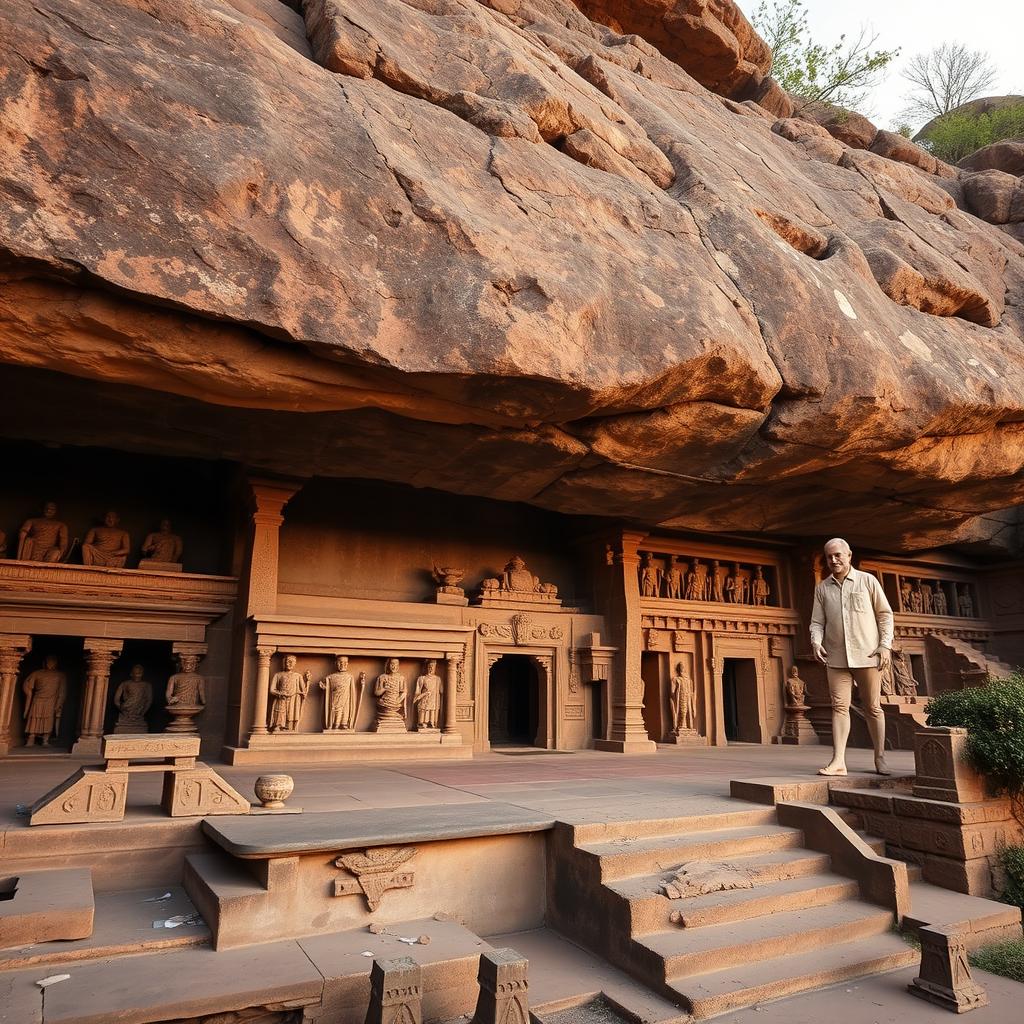
The rock-cut cave complexes at Udayagiri and Khandagiri hills, located on the outskirts of modern Bhubaneswar, represent the most tangible and visually spectacular legacy of Kharavela’s reign. These caves, numbering approximately eighteen at Udayagiri and fifteen at Khandagiri, were excavated primarily during the reign of Kharavela and in the period immediately following his rule. They served as monastic residences for Jain ascetics, providing shelter during the four months of the monsoon season when wandering was prohibited by Jain religious rules. The Ranigumpha cave at Udayagiri is the largest and most ornate of these structures, featuring a two-story layout with multiple cells, a spacious courtyard, and rich sculptural embellishments including scenes from Jain mythology, royal processions, hunting scenes, and decorative motifs drawn from both religious and secular traditions. Other notable caves include the Hathi Gumpha itself, which takes its name from the elephant-shaped facade carved above the inscription, the Ganesh Gumpha with its elaborate carvings of elephants and guardians, and the Jaya Vijaya Gumpha with its impressive pillared verandah. The architectural style of these caves represents an important early phase of Indian rock-cut architecture, predating the more famous Buddhist caves of western India such as Ajanta and Karle. The sculptural program of the caves reveals a high degree of artistic sophistication, combining indigenous Kalingan aesthetic traditions with influences from the broader Mauryan and post-Mauryan artistic koine. The caves also contain numerous inscriptions, mostly donor records, that provide valuable information about the social structure, naming conventions, and religious practices of the period. Taken together, the Udayagiri-Khandagiri cave complex is not merely an archaeological site but a sacred landscape that embodies the spiritual, artistic, and political aspirations of Kharavela’s Kalinga.
Cultural Achievements and the Kalingan Renaissance
The reign of Kharavela witnessed a cultural flowering that transformed Kalinga into one of the most intellectually and artistically vibrant regions of ancient India. The Hathigumpha inscription itself, with its sophisticated literary style and complex compositional structure, attests to a high level of literary culture at the Kalingan court. The language of the inscription, while technically Prakrit, displays a remarkable range of vocabulary and rhetorical devices, suggesting the existence of a cultivated literary tradition that extended well beyond mere administrative record-keeping. Kharavela’s patronage extended to music, dance, and the performing arts, as indicated by references in the inscription to festive celebrations involving musicians, dancers, and theatrical performances. The sculptural art of the Udayagiri and Khandagiri caves reveals an aesthetic sensibility that valued both naturalistic detail and symbolic depth, producing works that could hold their own against the best contemporary art from any part of the subcontinent. The cultural achievements of Kharavela’s reign also had a distinctly pan-Indian character, reflecting Kalinga’s engagement with the broader cultural currents of the time through trade, diplomacy, and intellectual exchange. The king’s ability to attract scholars, artisans, and religious figures from different parts of India to his court speaks to the cosmopolitan character of Kalingan culture under his patronage. This cultural renaissance was not an isolated or ephemeral phenomenon but laid the foundations for the subsequent artistic and architectural traditions that would culminate in the great temples of Bhubaneswar, Puri, and Konark in later centuries. Kharavela’s reign thus represents a critical formative period in the cultural evolution of Odisha, establishing patterns of artistic excellence and religious pluralism that would define Odia civilization for millennia to come.
Economic Prosperity and Maritime Connections
The military campaigns and cultural projects of Kharavela would not have been possible without a strong economic foundation, and the Hathigumpha inscription provides important clues about the economic prosperity of Kalinga during his reign. The region had long been known for its wealth, derived from its fertile agricultural plains, rich mineral resources including iron and precious stones, and its strategic position on the Bay of Bengal that facilitated maritime trade with Southeast Asia, Sri Lanka, and other parts of the Indian Ocean world. Kharavela’s military expeditions to the south and west likely opened up new trade routes and secured commercial interests, while the peaceful conditions within Kalinga during periods between campaigns would have encouraged agricultural production and internal trade. The construction and renovation of cities, forts, and cave complexes required significant material resources and skilled labor, both of which appear to have been available in abundance. The inscription’s references to the king’s generosity in distributing wealth, organizing public festivals, and supporting religious institutions suggest a revenue surplus that enabled conspicuous public expenditure. Kalinga’s maritime connections, which had been established centuries before Kharavela’s reign and would continue to flourish in subsequent periods, provided access to luxury goods and exotic products that enhanced the material culture of the kingdom. The economic prosperity of Kharavela’s Kalinga was thus the product of a synergistic combination of agricultural productivity, mineral wealth, internal trade, and international commerce, all managed by an efficient administrative apparatus that could mobilize and direct resources effectively.
Historical Significance and Legacy of Kharavela
The historical significance of Kharavela extends far beyond the boundaries of ancient Kalinga and the chronological limits of his own reign. In the context of Odia history and identity, Kharavela occupies a position of unparalleled importance as the archetypal Odia hero-king who restored the political independence and cultural dignity of the Kalingan people after the humiliation of Ashoka’s conquest. His legacy has been invoked across centuries by Odia poets, historians, and political leaders as a symbol of Odia pride, resilience, and cultural achievement. The modern state of Odisha has adopted numerous symbols and institutions associated with Kharavela, including the Kalinga Airlines of the 1950s, the Kharavela Award for excellence in various fields, and the prominent placement of his image in public spaces and official iconography. In the broader context of Indian history, Kharavela’s reign provides crucial evidence for the political configuration of the post-Mauryan period, demonstrating that the decline of the Mauryan Empire did not lead to political fragmentation alone but also to the rise of powerful regional kingdoms that competed for supremacy on a subcontinental scale. His military encounters with the Shungas and the Satavahanas help historians reconstruct the geopolitical dynamics of 2nd century BCE India, while his patronage of Jainism contributes to our understanding of the spread and regional variations of this ancient faith. The Hathigumpha inscription remains an indispensable primary source for Indian epigraphy, paleography, and historical chronology, and its continued study yields new insights and debates with each passing decade. Kharavela’s legacy also resonates with contemporary discussions about cultural heritage, as the Udayagiri-Khandagiri caves face ongoing threats from urbanization, pollution, and inadequate conservation. The story of Kharavela is ultimately the story of Kalinga’s assertion of its place in the ancient world, a story of military valor, administrative competence, artistic excellence, and religious devotion that continues to inspire and inform our understanding of one of India’s most historically rich and culturally vibrant regions.