ଓଡ଼ିଶା ପର୍ଯ୍ୟଟନ ଗାଇଡ୍: ପୁରୀ, କୋଣାର୍କ, ଚିଲିକା ଓ ଭୁବନେଶ୍ୱର
ଓଡ଼ିଶା ପର୍ଯ୍ୟଟନର ପ୍ରାଣକେନ୍ଦ୍ର ଏହି ଚାରି ସ୍ଥାନ — ପ୍ରାଚୀନ ମନ୍ଦିର, ସମୁଦ୍ର, ହ୍ରଦ ଓ ରାଜଧାନୀର ମିଶ୍ରଣ:
- ପୁରୀ: ଜଗନ୍ନାଥ ମନ୍ଦିର ଓ ସ୍ୱର୍ଣ୍ଣ ବେଳାଭୂମି — ଶ୍ରୀକ୍ଷେତ୍ର ଗାଇଡ୍।
- କୋଣାର୍କ: ୟୁନେସ୍କୋ ବିଶ୍ୱ ଐତିହ୍ୟ ସୂର୍ଯ୍ୟ ମନ୍ଦିର ଓ ଚନ୍ଦ୍ରାଭାଗା ବେଳାଭୂମି।
- ଚିଲିକା: ଏସିଆର ବୃହତ୍ତମ କ୍ଷାରୀୟ ହ୍ରଦ, ଶୀତ ପକ୍ଷୀ ଓ ଇରାବଡ଼ି ଡଲ્ଫିନ — ଅଲଗା ପ୍ରସଙ୍ଗ।
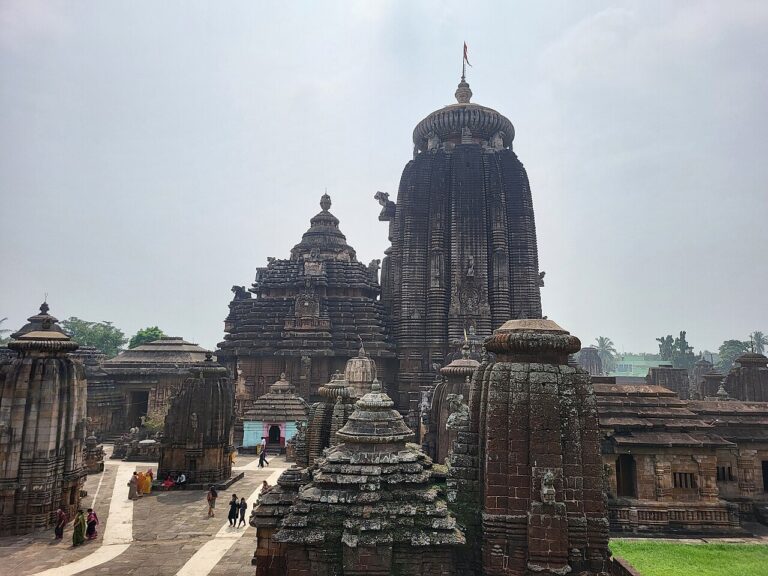
- ଭୁବନେଶ୍ୱର: ମନ୍ଦିର ନଗରୀ — ଲିଙ୍ଗରାଜ, ମୁକ୍ତେଶ୍ୱର, ଉଦୟଗିରି-ଖଣ୍ଡଗିରି ଗୁମ୍ଫା।
ସମୟ: ଅକ୍ଟୋବର-ଫେବୃଆରୀ ସର୍ବୋତ୍କୃଷ୍ଟ। ପୁରୀରୁ କୋଣାର୍କ ୩୫ କିମି, ଚିଲିକା (ସତପଡ଼ା) ୫୦ କିମି, ଭୁବନେଶ୍ୱର ୬୦ କିମି — “ସୁବର୍ଣ୍ଣ ତ୍ରିକୋଣ” ଭାବରେ ପରିଚିତ ଏହି ପଥ ୩-୪ ଦିନରେ ଶେଷ ହୁଏ।
In English
The Sacred Landscape of Ekamra Kshetra
Bhubaneswar, the capital city of Odisha, stands as a living testament to the spiritual and architectural grandeur of ancient Kalinga. Known since antiquity as Ekamra Kshetra, meaning the sacred land of the mango groves, this city has been a revered pilgrimage destination for devotees of Lord Shiva for over two millennia. The very name Ekamra Kshetra finds its mention in ancient Sanskrit texts, Puranas, and copperplate inscriptions, establishing its significance as one of the five great Shiva Kshetras of India. The city derives its modern name from Tribhubaneswar, meaning the Lord of the Three Worlds, a title that refers to Lord Shiva himself. Walking through the old quarters of Bhubaneswar, one can still feel the divine energy that has drawn saints, kings, and devotees to this hallowed ground for centuries. The sacred Bindusagar Lake, believed to contain water from all holy rivers of India, remains the spiritual centerpiece around which the temple civilization of Bhubaneswar flourished and expanded.
The Magnificent Legacy of Seven Hundred Temples
Bhubaneswar is often described as a museum of temples, and for good reason. The city and its immediate surroundings are home to more than seven hundred temples, spanning a period from the sixth century to the sixteenth century of the Common Era. This extraordinary concentration of sacred structures is unparalleled in the Indian subcontinent and offers scholars, historians, and devotees an unbroken narrative of religious evolution, artistic refinement, and architectural innovation. These temples were not merely places of worship; they were the focal points of community life, centers of learning, repositories of artistic achievement, and symbols of royal patronage. Each dynasty that ruled over Kalinga, from the Sailodbhavas and Bhaumakaras to the Somavamsis and the mighty Gajapatis, contributed to this ever-expanding sacred landscape. The temples of Bhubaneswar collectively represent the most comprehensive archive of Kalinga architecture anywhere in the world, making the city an indispensable destination for understanding the deeper currents of Indian civilization.
Lingaraj Temple: The Sovereign Among Temples
Towering over the skyline of the old city, the Lingaraj Temple stands as the undisputed monarch among the temples of Bhubaneswar. Dedicated to Lord Harihara, a combined form of Lord Shiva and Lord Vishnu, this magnificent structure represents the pinnacle of Kalinga temple architecture. Built during the reign of the Somavamsi king Yayati Kesari in the eleventh century, the Lingaraj Temple rises to a height of nearly one hundred and eighty feet, its curvilinear spire dominating the surrounding landscape with an authority that is both architectural and spiritual. The temple complex is enclosed by a massive boundary wall and contains over one hundred and fifty subsidiary shrines, making it a temple city within the temple city itself. The sanctum sanctorum houses the swayambhu lingam, which is unique in that it is worshipped as both Shiva and Vishnu, reflecting the syncretic traditions that have long characterized Odia religious life. The elaborate carvings on the temple walls depict scenes from the Ramayana, Mahabharata, and various Puranic legends, alongside exquisite representations of divine nymphs, celestial musicians, and mythical creatures. The Bindusagar Lake adjacent to the temple is integral to the ritual life of the shrine, with devotees taking sacred dips before offering prayers.
Mukteshwar Temple: The Gem of Kalinga Architecture
If the Lingaraj Temple represents the mature grandeur of Kalinga architecture, the Mukteshwar Temple represents its most refined and elegant expression. Often referred to as the gem of Odishan architecture, this tenth-century masterpiece is celebrated for its perfect proportions, delicate ornamentation, and the exquisite torana, or ceremonial gateway, that stands before it. The torana of Mukteshwar is an architectural marvel in itself, featuring finely carved scrollwork, dwarf figures, and intricate motifs that anticipate the rich decorative traditions of later Odishan temples. The temple is dedicated to Lord Shiva and marks a significant transition in the evolution of Kalinga architecture, bridging the earlier style seen at Parasurameshwar with the fully developed form evident at Lingaraj. The interior of the temple contains some of the finest sculptures of the period, including a celebrated image of a meditating ascetic, scenes of women in various poses of adornment, and a remarkable panel depicting the marriage of Shiva and Parvati. The octagonal compound wall surrounding the temple is another distinctive feature, creating an intimate sacred space that draws the visitor into a world of spiritual contemplation and artistic appreciation.
Rajarani Temple: The Poetic Vision in Stone
The Rajarani Temple, believed to have been constructed in the eleventh century, occupies a special place in the temple architecture of Bhubaneswar for its distinctive aesthetic character and the absence of a presiding deity, which has led scholars to debate its original purpose. The temple derives its popular name from the reddish-gold sandstone, known as rajarania, used in its construction, which gives the structure a warm, luminous quality that changes hue with the shifting light of day. Unlike most temples in Bhubaneswar, which are dedicated to Shiva, the Rajarani Temple is associated with the worship of Vishnu, though some scholars have suggested connections with tantric practices. What sets the Rajarani Temple apart is the extraordinary quality of its sculptural decoration, particularly the graceful figures of celestial maidens, or dikpalas, that adorn its walls. These sculptures are remarkable for their sinuous grace, elaborate hairstyles, and expressive faces, representing some of the finest examples of medieval Indian feminine iconography. The temple also features some of the earliest depictions of the dance form that would later evolve into the classical Odissi dance, making it an invaluable resource for dance historians and cultural scholars.
Parasurameshwar Temple: The Ancient Foundation
The Parasurameshwar Temple stands as the oldest surviving temple in Bhubaneswar, dating to the seventh century during the reign of the Sailodbhava dynasty. This small but historically significant shrine provides crucial insights into the early stages of Kalinga temple architecture, before the style reached its mature form. Dedicated to Lord Shiva, the temple features a relatively low curvilinear tower, a flat-roofed assembly hall, and walls covered with elaborate carvings that reveal a style still in the process of defining its distinctive identity. The sculptures of Parasurameshwar display a certain raw energy and spontaneity that distinguishes them from the more polished works of later centuries. Notable among these are the depictions of Shiva in various forms, scenes of martial combat, and a remarkable series of amorous couples that reflect the liberal artistic conventions of the period. The presence of a naga, or serpent deity, shrine within the compound points to the assimilation of indigenous animistic traditions into the Brahmanical framework, a process that was still very much underway when this temple was built. For historians and architecture enthusiasts, Parasurameshwar offers an irreplaceable window into the formative centuries of one of India’s great architectural traditions.
The Evolution of Kalinga Architecture
The temples of Bhubaneswar collectively document the complete evolutionary trajectory of Kalinga architecture, making the city an open textbook for students of Indian temple design. The Kalinga style is distinguished by several characteristic features: the curvilinear tower, or rekha deul, that rises above the sanctum; the pidha deul, or pyramidal roof, that crowns the assembly hall; the elaborate scrollwork and floral motifs that decorate the walls; and the distinctive khakhara mundi arches that frame many of the sculptural panels. Over the centuries, these elements underwent a continuous process of refinement and elaboration. The early temples like Parasurameshwar display a certain simplicity and directness in their design, with relatively modest towers and straightforward layouts. By the time of Mukteshwar in the tenth century, the style had achieved a remarkable elegance and balance, with more sophisticated proportions and more intricate decorative schemes. The eleventh and twelfth centuries, represented by Lingaraj and the temples at Puri and Konark, witnessed the full flowering of the style, with towers reaching unprecedented heights, walls becoming canvases for extraordinarily complex sculptural programs, and the overall architectural conception achieving a level of grandeur and unity that ranks among the finest achievements of Indian civilization.
From Ancient Capital to Modern Metropolis
The transformation of Bhubaneswar from an ancient temple town to a modern capital city is a narrative that encompasses both continuity and dramatic change. For centuries after the decline of the Gajapati dynasty, Bhubaneswar existed primarily as a religious center, its glory days seemingly behind it. The decision to make it the capital of the newly formed state of Odisha in 1948 marked the beginning of a new chapter. The legendary German architect Otto Königsberger was commissioned to design the modern city, and his master plan envisioned a harmonious coexistence between the ancient temple quarter and the new administrative and residential areas. This planned approach to urban development was pioneering in post-independence India, and it gave Bhubaneswar a distinctive character that set it apart from other state capitals. Over the decades that followed, the city expanded rapidly, absorbing surrounding villages and developing new neighborhoods, commercial centers, and institutional complexes. Yet through all this growth, the old temple quarter has retained its sacred identity, creating a fascinating urban landscape where thousand-year-old shrines stand in the shadow of modern buildings and ancient rituals continue uninterrupted beside busy thoroughfares.
Smart City Bhubaneswar: Embracing the Future
In recent years, Bhubaneswar has emerged as one of the leading cities under India’s Smart City Mission, demonstrating a commitment to leveraging technology and innovation for urban improvement while respecting its cultural heritage. The smart city initiative has brought significant investments in digital infrastructure, intelligent traffic management, water supply systems, waste management, and public service delivery. The development of the Smart City Operation Center has provided the municipal administration with real-time monitoring capabilities across multiple urban systems, enabling more responsive and efficient governance. Special attention has been given to the heritage zone surrounding the temples, with projects aimed at pedestrianizing certain areas, improving signage and interpretation facilities, and creating visitor amenities that enhance the experience without compromising the sacred character of the space. The transformation of the Ekamra Haat into a vibrant cultural marketplace, the development of waterfront areas along the Daya and Kuakhai rivers, and the creation of extensive cycling networks reflect a holistic approach to urban development that seeks to make Bhubaneswar not just smarter but more livable, sustainable, and culturally vibrant.
Utkal University: The Intellectual Heartbeat
The establishment of Utkal University in 1943 marked a watershed moment in the intellectual history of Odisha and added a significant new dimension to the identity of Bhubaneswar. As the oldest university in the state, Utkal University has served as the principal nursery of educated leadership, scholarly research, and cultural awareness for nearly eight decades. The university campus, spread across a sprawling area in the western part of the city, has been home to generations of scholars who have made distinguished contributions to fields ranging from Odia literature and history to science and technology. The Department of History at Utkal University has been particularly influential in shaping the scholarly understanding of Kalinga’s past, and many of the most important studies of Odishan temple architecture, epigraphy, and art history have emerged from this institution. The university has also played a crucial role in documenting and preserving the tribal heritage of Odisha, making it an indispensable resource for anyone seeking to understand the full cultural complexity of the region. Beyond its academic contributions, Utkal University has been a catalyst for the cultural life of Bhubaneswar, hosting literary festivals, art exhibitions, theatrical performances, and intellectual conferences that have enriched the city’s urban experience.
The Tribal Museum: Celebrating Indigenous Heritage
The Museum of Tribal Art and Artefacts in Bhubaneswar stands as one of the finest institutions of its kind in India, offering visitors an immersive introduction to the extraordinarily rich and diverse tribal cultures of Odisha. The state is home to sixty-two distinct tribal communities, including particularly significant populations of Santhals, Mundas, Oraons, Kondhs, and Bhotras, each with their own unique languages, belief systems, artistic traditions, and social structures. The museum’s extensive collections include traditional textiles, ornaments, weapons, musical instruments, household objects, and ritual artifacts that collectively illuminate the full spectrum of tribal life in Odisha. The open-air exhibition within the museum complex is especially noteworthy, featuring full-scale replicas of tribal dwellings from different communities, complete with authentic architectural details and surrounding landscapes. This thoughtful presentation allows visitors to appreciate not just individual objects but the complete environmental and cultural contexts in which they are created and used. The museum also serves an important educational function, organizing workshops, demonstrations, and outreach programs that help preserve traditional crafts and knowledge systems that might otherwise be lost to the pressures of modernization.
The Living Continuum of a Sacred City
What makes Bhubaneswar truly extraordinary is not merely the number or antiquity of its temples but the living continuity that connects the ancient past to the dynamic present. Unlike many heritage cities in India where the old has been overwhelmed by the new, Bhubaneswar has managed to maintain a meaningful dialogue between its sacred heritage and its modern aspirations. Every morning, as the sun rises over the Lingaraj Temple and the priests begin their rituals, the city simultaneously comes alive with the activities of a twenty-first-century metropolis. Students hurry to classes at Utkal University, IT professionals commute to the Infocity campus, and smart city systems hum with digital activity, all within the shadow of temples that have witnessed the rise and fall of empires. This layered quality, where multiple centuries coexist in a single urban space, gives Bhubaneswar a depth and richness that few Indian cities can match. As the city continues to grow and evolve, the challenge and the opportunity lie in ensuring that this remarkable continuum remains unbroken, that the Ekamra Kshetra of the future honors the spiritual and artistic legacy of the Ekamra Kshetra of the past while embracing the possibilities of a new age. In this balance between tradition and modernity, Bhubaneswar offers not just a lesson in urban planning but a profound meditation on the nature of Indian civilization itself.