In English
The Magnificent Lingaraj Temple of Bhubaneswar
The Lingaraj Temple stands as the crowning jewel of Bhubaneswar, the temple city of Odisha, and holds the distinguished reputation of being the largest Shiva temple in the entire region. Dedicated to Harihara, a combined form of Lord Shiva and Lord Vishnu, this sacred edifice draws millions of devotees, historians, and architecture enthusiasts from across the globe every year. The temple represents the pinnacle of Kalinga architecture and serves as a living testament to the extraordinary artistic and spiritual legacy of ancient Odisha. Rising to a height of approximately 54 meters, the towering spire of the Lingaraj Temple dominates the Bhubaneswar skyline, offering a breathtaking glimpse into the grandeur of medieval Indian temple construction. The very name Lingaraj translates to the King of Lingas, signifying the supreme status accorded to the presiding deity within the pantheon of Shaivite worship in Odisha and beyond.
ସାଳେଶ୍ୱରୀ ମନ୍ଦିର: ସମ୍ବଲପୁରର ଆଦିଶକ୍ତିSamaleswari Temple: The Presiding Goddess of Sambalpur
Historical Legacy of the Somavamsi Dynasty
The construction of the Lingaraj Temple is historically attributed to the Somavamsi dynasty, which ruled over the region during the 11th century. King Yayati Kesari is widely credited with commissioning this monumental structure, though historical evidence suggests that the temple complex evolved over several centuries with contributions from successive rulers. The Somavamsis were devout Shaivites, and their patronage of temple architecture reached its zenith during this period. The political stability and economic prosperity of their reign allowed for the mobilization of vast resources, skilled artisans, and architectural innovation on an unprecedented scale. Inscriptions found within the temple premises provide valuable insights into the chronological development of the complex, revealing that while the core structure dates to the 11th century, certain elements may trace their origins to earlier periods, possibly as far back as the 7th century. This layered historical narrative makes the Lingaraj Temple not merely a single monument but a palimpsest of Odisha’s dynastic history, reflecting the artistic sensibilities and religious fervor of multiple generations of rulers who each left their indelible mark on this sacred site.
The Pinnacle of Kalinga Architecture
The Lingaraj Temple is universally regarded as the finest exemplar of the Kalinga school of architecture, which represents a distinct and highly refined tradition of temple building that flourished in ancient Odisha. The temple follows the traditional rekha deula architectural style, characterized by a curvilinear tower that rises dramatically from a square base, culminating in a finely carved kalasha or pot-shaped finial at the summit. The main sanctuary, known as the vimana, houses the sacred lingam and is connected to the jagamohana or assembly hall through a transitional vestibule. The walls of the temple are adorned with extraordinarily detailed sculptures depicting a vast pantheon of Hindu deities, celestial beings, mythical creatures, scenes from daily life, and erotic motifs that reflect the tantric traditions prevalent during the period. Every square inch of the exterior surface has been carved with meticulous precision, creating a visual encyclopedia of Hindu mythology and medieval Odishan culture. The architectural sophistication is evident in the precise mathematical calculations underlying the temple’s proportions, the innovative structural techniques employed to achieve the towering height, and the seamless integration of sculptural decoration with the architectural framework. The pyramidal roof of the jagamohana, with its receding tiers and ornamental pinnacles, complements the soaring vimana in a harmonious composition that has inspired generations of architects and continues to be studied as a masterpiece of Indian temple architecture.
The Sacred Bindusagar Tank
Adjacent to the Lingaraj Temple lies the Bindusagar tank, a vast artificial water body that occupies a central position in the temple complex and holds immense religious significance in the ritual traditions associated with the temple. According to Hindu mythology, the tank was created by Lord Shiva himself to quench the thirst of the goddess Parvati, and its waters are believed to contain water from every holy river, pond, and stream in India, brought here by countless celestial beings. The name Bindusagar literally translates to Ocean of Drops, and a single dip in its sacred waters is considered equivalent to performing pilgrimages to all major Hindu tirthas or sacred crossing places across the subcontinent. The tank is surrounded by a series of stone steps leading down to the water, and its periphery is dotted with numerous smaller shrines dedicated to various deities. The Bindusagar serves as the focal point for several important rituals, including the ceremonial bath of the presiding deity during special occasions and festivals. The reflection of the temple spire in the tranquil waters of the tank creates a picture of ethereal beauty, particularly during sunrise and sunset, making it one of the most photographed and visually iconic elements of the Bhubaneswar temple landscape.
150 Subsidiary Shrines Within the Complex
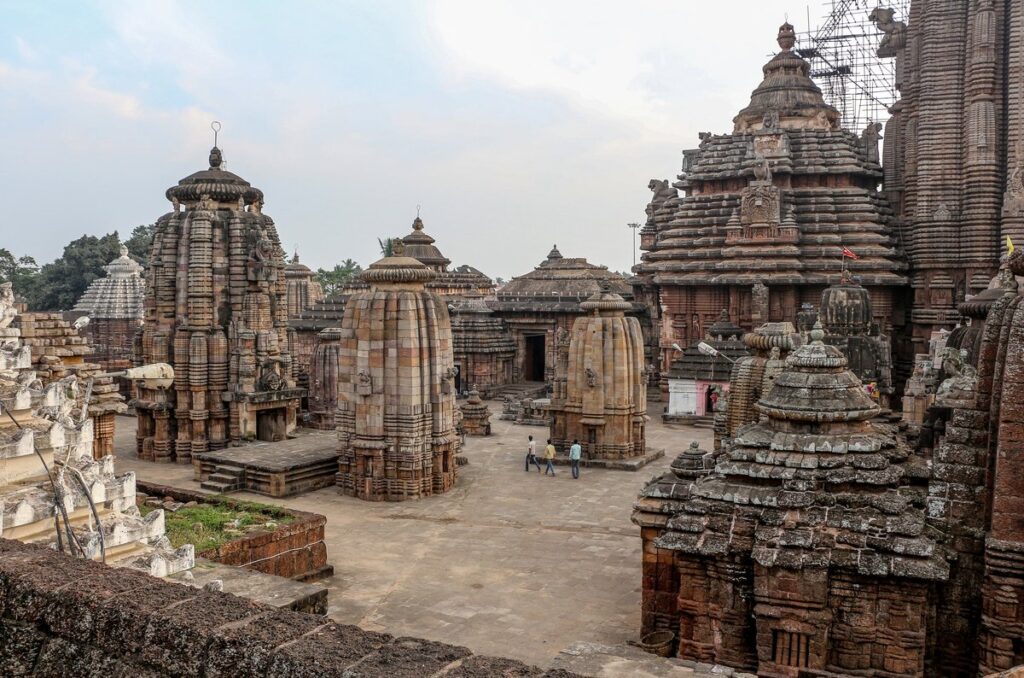
One of the most remarkable features of the Lingaraj Temple complex is the presence of approximately 150 subsidiary shrines that surround the main temple within the enclosed precinct. These smaller shrines, varying in size from modest single-chamber structures to more elaborate multi-towered edifices, are dedicated to a diverse array of deities from the Hindu pantheon, including various forms of Shiva, Vishnu, Durga, Ganesha, Kartikeya, and numerous lesser-known regional and folk deities. This constellation of smaller temples creates a veritable temple city within the larger complex, offering visitors a comprehensive survey of the devotional practices and theological diversity that characterized medieval Odishan Hinduism. Many of these subsidiary shrines are architecturally significant in their own right, representing different periods of construction and exhibiting variations in style, iconography, and decorative motifs. The spatial arrangement of these shrines follows a carefully planned hierarchical order, with the most important ones located closest to the main temple and the lesser ones positioned progressively further away. Together, they form an integrated sacred landscape that transforms the act of visiting the Lingaraj Temple from a single-point pilgrimage into an immersive journey through the entire spectrum of Hindu devotional tradition.
Daily Rituals and Sacred Ceremonies
The Lingaraj Temple maintains an unbroken tradition of daily rituals that have been performed with remarkable continuity for nearly a thousand years, making it one of the most actively functioning medieval temples in India. The day begins in the early hours of the morning with the Mangal Arati, when the deity is awakened with the chanting of Vedic hymns, the sounding of conch shells and bells, and the waving of oil lamps before the sanctum. This is followed by a series of elaborate rituals including the Abhisheka, or ceremonial bathing of the lingam with various sacred substances including water, milk, honey, sandalwood paste, and bael leaves. The deity is then dressed in fresh garments and adorned with elaborate ornaments and flower garlands in a ritual known as Alankara. Throughout the day, devotees are granted darshan or sacred viewing of the deity at specified intervals, and offerings of food, flowers, and other items are accepted on their behalf. The Bhog or sacred food offering is prepared in the temple kitchen following strict traditional recipes and is later distributed to devotees as prasad. The evening rituals include the Sandhya Arati and the ceremonial procession of the representative idol known as the chalanti pratima around the temple precincts. Each of these rituals is accompanied by specific prayers, musical compositions, and ceremonial actions that have been codified in ancient temple manuals and transmitted through generations of hereditary priests known as Badus, who alone are permitted to enter the innermost sanctum and perform the most sacred rites.
The Grand Celebration of Shivaratri
Among the numerous festivals celebrated at the Lingaraj Temple, Maha Shivaratri stands out as the most grand and spectacular occasion, drawing hundreds of thousands of devotees from across Odisha and neighboring states. The festival, which commemorates the divine marriage of Lord Shiva and Goddess Parvati, transforms the entire temple complex and the surrounding areas of Bhubaneswar into a massive ceremonial ground pulsating with spiritual energy. The celebrations begin several days before the actual festival day with elaborate preparations including the cleaning and decoration of the temple, the procurement of vast quantities of flowers, fruits, and other ritual materials, and the arrangement of facilities for the expected influx of pilgrims. On the night of Shivaratri, the temple remains open throughout the night, and devotees observe fasts and maintain vigil, performing continuous abhisheka of the lingam with milk, water, and bael leaves while chanting the sacred Panchakshara mantra. The temple premises are illuminated with thousands of oil lamps and electric lights, creating a mesmerizing visual spectacle. Processions of decorated palanquins carrying the representative deities, accompanied by traditional music and dance performances, wind through the streets surrounding the temple. The fair held in conjunction with the festival features traditional handicrafts, folk performances, and local cuisine, making it a comprehensive celebration of Odishan culture alongside its primary religious significance.
Archaeological and Historical Importance
The Lingaraj Temple holds immense archaeological significance as a primary source for understanding the evolution of temple architecture, iconography, and religious practices in eastern India. The temple complex serves as an open-air museum of medieval Indian art, with its sculptures providing invaluable evidence of the stylistic developments, technological capabilities, and aesthetic preferences of the period. Archaeologists and art historians have studied the temple extensively to trace the development of the Kalinga architectural style from its early experimental phases to its mature classical expression as embodied in the Lingaraj structure. The numerous inscriptions found on the temple walls, written in Sanskrit and Odia using various scripts including proto-Oriya and Kutila, offer crucial documentary evidence for reconstructing the political history, administrative systems, economic conditions, and social organization of medieval Odisha. These inscriptions record land grants, endowments, ritual prescriptions, and historical events that complement and sometimes contradict literary sources, providing a more nuanced understanding of the period. The temple also provides important evidence for the study of medieval Indian metallurgy, particularly in the iron beams used in the construction, and for understanding the urban planning and water management systems of historical Bhubaneswar, of which the temple was the central focal point.
Tourism and Visitor Experience
As one of the premier tourist destinations in Odisha, the Lingaraj Temple attracts visitors throughout the year, contributing significantly to the cultural tourism economy of Bhubaneswar. The temple is conveniently located in the old town area of the city, which itself forms a compact heritage zone containing numerous other important temples, making it possible for tourists to experience a dense concentration of medieval architecture within a relatively small geographical area. The Odisha Tourism Development Corporation and the Archaeological Survey of India have made significant efforts to enhance the visitor experience through improved infrastructure, informational signage, guided tour facilities, and the maintenance of surrounding gardens and public spaces. The temple is particularly popular during the winter months from October to March when the climate is pleasant for extended sightseeing. Photography is restricted within the temple premises in keeping with its active religious function, though the exterior views from various vantage points around the complex offer exceptional opportunities for architectural photography. The proximity of the temple to other major attractions including the Mukteshwar Temple, Rajarani Temple, and the Odisha State Museum makes it an essential component of any comprehensive Bhubaneswar heritage itinerary. Local guides, many of whom possess deep knowledge of the temple’s history, architecture, and ritual traditions, are available to provide detailed tours that greatly enrich the visitor experience and help contextualize the temple within the broader framework of Indian cultural heritage.
A Living Legacy of Devotion and Artistry
The Lingaraj Temple of Bhubaneswar transcends its physical dimensions and architectural grandeur to embody the living spirit of a civilization that found its highest expression in the marriage of artistic excellence and spiritual devotion. For over a millennium, this sacred structure has stood as a beacon of Shaivite worship, a center of community life, a school of traditional arts and crafts, and a symbol of Odia cultural identity. Despite the passage of centuries, the political upheavals that reshaped the region, and the transformative forces of modernity, the temple has maintained its religious vitality and continued relevance in the lives of millions of devotees. The continuity of its ritual traditions, the preservation of its architectural integrity, and the unwavering faith of its visitors testify to the enduring power of the cultural vision that gave birth to this extraordinary monument. As Bhubaneswar continues to grow and modernize as a major Indian city, the Lingaraj Temple remains its spiritual heart, anchoring the present to the past and reminding all who visit of the heights that human creativity and devotion can achieve when united in the pursuit of the divine. The temple stands not merely as a relic of a bygone era but as a vibrant, evolving institution that continues to write new chapters in its already magnificent story.