ଗଜପତି ରାଜବଂଶ: ଓଡ଼ିଶାର ସ୍ୱର୍ଣ୍ଣ ଯୁଗ
୧୪୩୪ ମସିହାରୁ ୧୫୪୧ ପର୍ଯ୍ୟନ୍ତ ଓଡ଼ିଶାର ଶାସନ କରିଥିବା ସୂର୍ଯ୍ୟବଂଶୀ ଗଜପତି ରାଜବଂଶ ମଧ୍ୟଯୁଗୀୟ ଓଡ଼ିଶାର ସର୍ବୋଚ୍ଚ ଶିଖର। ପ୍ରତିଷ୍ଠାତା କପିଳେନ୍ଦ୍ର ଦେବ (ଶାସନ ୧୪୩୪-୧୪୬୭) ସାମ୍ରାଜ୍ୟକୁ ଗଙ୍ଗାଠାରୁ କାବେରୀ ପର୍ଯ୍ୟନ୍ତ ବିସ୍ତାର କରିଥିଲେ।
ଉଲ୍ଲେଖଯୋଗ୍ୟ ଶାସକ
- କପିଳେନ୍ଦ୍ର ଦେବ: ଉତ୍କଳର ଏକଛତ୍ର ସମ୍ରାଟ; “ଗଜପତି ଗୌଡେଶ୍ୱର” ଉପାଧି।
- ପୁରୁଷୋତ୍ତମ ଦେବ (୧୪୬୭-୧୪୯୭): କାବ୍ୟକାର ରାଜା — “ଅଭିନବ ଗୀତଗୋବିନ୍ଦ” ରଚନା।
- ପ୍ରତାପରୁଦ୍ର ଦେବ (୧୪୯୭-୧୫୪୦): ଶେଷ ମହାନ ଗଜପତି; ଶ୍ରୀଚୈତନ୍ୟଙ୍କ ସହ ସମ୍ପର୍କ।
ଏହି ଯୁଗରେ ଜଗନ୍ନାଥ ସଂସ୍କୃତି, ଓଡ଼ିଆ ସାହିତ୍ୟ ଓ ପୁରୀର ମନ୍ଦିର ପରମ୍ପରା ନୂତନ ଉଚ୍ଚତା ପାଇଲା; ଆଜି ମଧ୍ୟ ପୁରୀର ରାଜା “ଗଜପତି ମହାରାଜା” ଭାବରେ ସମ୍ମାନିତ।
In English
The Rise of the Gajapati Dynasty: Foundation of an Empire
The Gajapati dynasty stands as the most glorious chapter in the medieval history of Odisha, representing an era when the region emerged as a paramount imperial power in eastern and southern India. The dynasty was founded by Kapilendra Dev, also known as Kapilesvara, who ascended the throne in 1434 after overthrowing the last ruler of the Eastern Ganga dynasty. The Eastern Gangas had ruled Odisha for nearly four centuries, but by the early fifteenth century, their authority had severely weakened due to internal dissension, fiscal exhaustion, and repeated invasions from the north. Kapilendra Dev, born in a humble family of the Khandayat community, rose through the ranks of the Ganga military establishment to become a powerful commander. Seizing upon the political instability, he deposed the reigning Ganga king Bhanudeva IV and established his own rule, laying the foundation of what would become one of the most expansive empires in Indian history.
The term “Gajapati” literally means “Lord of Elephants,” a title that carried profound symbolic significance in Odishan political tradition. The ruler was considered the divine servant of Lord Jagannath, and his authority was legitimised through his role as the protector of the deity and his temple at Puri. Kapilendra Dev adopted this title with great deliberation, consciously positioning himself within an ancient legitimising framework that connected his rule to the sacred traditions of the land. This fusion of political ambition and religious sanction would become the defining characteristic of Gajapati sovereignty throughout the dynasty’s existence.
Kapilendra Dev: The Architect of Imperial Expansion
Kapilendra Dev was undoubtedly one of the most remarkable military strategists and empire-builders in medieval Indian history. Within a few years of assuming power, he launched a series of audacious military campaigns that dramatically expanded the boundaries of the Odishan state. His vision was nothing less than the establishment of a pan-Kalinga empire that would encompass the entire eastern coastline from the Ganga in the north to the Godavari in the south. This territorial ambition was rooted in both strategic considerations and a deep-seated historical consciousness that recalled the ancient boundaries of the Kalinga and Trikalinga realms described in classical sources.
The northern campaigns of Kapilendra Dev brought under his control the regions of Bengal up to the Ganga, including the important territories of Midnapore, Burdwan, and parts of modern-day West Bengal. These conquests gave the Gajapati empire access to the rich trade networks of the Gangetic delta and control over important riverine routes. However, it was the southern campaigns that truly demonstrated the military prowess of Kapilendra Dev. He pushed his armies deep into the Deccan, conquering the fertile deltas of the Krishna and Godavari rivers, and bringing the powerful Reddi kingdoms of Rajahmundry and Kondavidu under his suzerainty. The Gajapati armies even advanced as far south as the Pennar River, posing a direct threat to the Vijayanagara Empire itself.
Kapilendra Dev’s military success was built upon a well-organised army that combined traditional Odishan warfare techniques with innovative tactical adaptations. The Odishan cavalry was particularly renowned, and the elephant corps formed the backbone of the military machine. The navy, often overlooked in historical accounts, played a crucial role in securing the extensive coastline and facilitating the movement of troops along the eastern seaboard. Kapilendra Dev also demonstrated considerable diplomatic skill, forming strategic alliances and exploiting the rivalries between neighbouring powers to his advantage.
Conflict with the Bahmani Sultanate
The rapid expansion of the Gajapati empire inevitably brought it into collision with the other great powers of the Deccan, most notably the Bahmani Sultanate. The Bahmani rulers, who controlled vast territories in the central Deccan, viewed the Odishan advance into the Krishna-Godavari delta with deep alarm. The region was not only agriculturally prosperous but also strategically vital, as it controlled access to the eastern coast and its lucrative maritime trade. The resulting conflict between the Gajapatis and the Bahmanis would shape the political geography of southern India for decades.
The most significant military confrontation occurred during the reign of Kapilendra Dev, when the Bahmani Sultan Humayun Shah launched a major offensive against Gajapati territories in the south. The Odishan forces, led by Kapilendra Dev’s able general and adopted son Hamvira Dev, initially suffered reverses but eventually succeeded in repelling the Bahmani incursions. The conflict continued in a series of campaigns and counter-campaigns, with both sides gaining and losing territories. The Bahmanis captured the strategic fortress of Kondavidu on one occasion, but the Gajapatis recovered it through a combination of military pressure and diplomatic manoeuvring. This protracted struggle exhausted both empires but ultimately demonstrated that the Gajapati military machine was capable of holding its own against one of the most powerful Islamic sultanates of the period.
Purushottama Dev and the Vijayanagara Wars
Kapilendra Dev was succeeded by his son Purushottama Dev, who ascended the throne around 1467 after a brief succession struggle with Hamvira Dev. Purushottama Dev inherited a vast empire but also the formidable challenges of defending it against powerful enemies. His reign is particularly noted for the intensification of conflict with the Vijayanagara Empire, which under its great ruler Krishnadevaraya would become the dominant power in southern India. The rivalry between the Gajapatis and Vijayanagara was essentially a contest for control over the eastern Deccan, particularly the rich Krishna-Godavari region that formed the breadbasket of both empires.
The conflict with Vijayanagara unfolded across multiple campaigns and spanned several decades. Purushottama Dev initially held his own against Vijayanagara pressure, but the tide began to turn when Krishnadevaraya launched his famous northern campaigns in the early sixteenth century. The Vijayanagara armies, renowned for their discipline and firepower, systematically dismantled Gajapati control over the southern territories. The decisive Battle of Kondavidu in 1515 marked the beginning of the end for Gajapati power in the Deccan. Krishnadevaraya captured the fortress after a prolonged siege, and subsequently overran the entire coastal region up to the Godavari. Purushottama Dev was forced to accept a humiliating treaty that significantly reduced the territorial extent of his empire.
The military reverses against Vijayanagara were compounded by internal challenges. The prolonged succession dispute at the beginning of Purushottama Dev’s reign had weakened the central administration, and the fiscal strain of maintaining a large military establishment over extended frontiers had begun to tell. Despite these difficulties, Purushottama Dev’s reign is remembered for its significant cultural and religious contributions, particularly the continued patronage of the Jagannath temple and the flourishing of Oriya literature.
Prataprudra Dev: The Last Great Gajapati
Prataprudra Dev, who came to power around 1497, is often regarded as the last great ruler of the Gajapati dynasty. His reign represents both the culmination of Gajapati cultural achievement and the beginning of the empire’s irreversible decline. Prataprudra Dev inherited an empire that had already lost much of its southern territories to Vijayanagara, and he faced the additional challenge of dealing with the rising power of the Afghan rulers in Bengal to the north. Despite these adverse circumstances, he proved to be an able administrator and a devout patron of religion and culture.
The northern frontier of the Gajapati empire came under increasing pressure from the Afghan sultans of Bengal, particularly during the reign of Sultan Hussain Shah. The Afghans launched repeated incursions into the Gajapati territories of Midnapore and southern Bengal, gradually eroding Odishan control over these regions. Prataprudra Dev mobilised his forces to meet this threat, and for a time succeeded in containing the Afghan advance. However, the simultaneous pressure from Vijayanagara in the south and Bengal in the north stretched Gajapati military resources to breaking point. Internal rebellions further weakened the empire, as provincial governors and local chieftains took advantage of the central government’s difficulties to assert their independence.
By the time of Prataprudra Dev’s death in 1541, the Gajapati empire had shrunk to a fraction of its former extent. The territories south of the Chilika Lake had been lost to Vijayanagara, and the northern regions beyond the Subarnarekha River had fallen under Afghan control. The once-mighty empire that had stretched from the Ganga to the Godavari was now confined essentially to the Odishan heartland. This dramatic contraction of territory marked the end of the imperial phase of Gajapati history, though the dynasty itself would continue to rule in diminished circumstances for several more centuries.
Jagannath Temple Patronage and Religious Policy
The most enduring legacy of the Gajapati dynasty is its intimate association with the Jagannath temple at Puri. The Gajapati rulers regarded themselves as the first servants of Lord Jagannath, and this relationship formed the ideological bedrock of their political authority. Every major political act, every military campaign, and every administrative decision was undertaken in the name of the deity. The coronation ceremony itself was not complete until the new ruler had received the symbolic gifts of a sword, a flag, and a conch shell from the temple, signifying that his authority derived entirely from his role as the divine patron’s representative on earth.
The Gajapati period witnessed massive investment in the expansion and beautification of the Jagannath temple complex. Kapilendra Dev, Purushottama Dev, and Prataprudra Dev all contributed substantially to the architectural enrichment of the temple. The famous Muktimandapa, the Niladri Vihara, and several other structures within the temple precincts were built or substantially renovated during this period. The rulers made lavish donations of land, gold, and precious stones to the temple, ensuring its economic prosperity and enabling the elaborate rituals and festivals that continue to this day. The grand car festival, or Rath Yatra, attained its present scale and splendour during the Gajapati period, reflecting the rulers’ desire to demonstrate their devotion through increasingly elaborate public spectacles.
The religious policy of the Gajapatis was characterised by a remarkable spirit of inclusivism. While they were staunch champions of Vaishnavism in its particular Odishan form centred on Jagannath, they also extended patronage to Shaivite and Shakta institutions. The great Shaivite centres at Bhubaneswar continued to receive royal support, and several important Shakta shrines were built or maintained with Gajapati funds. This religious eclecticism helped to maintain social harmony in an empire that encompassed diverse ethnic and linguistic communities, each with their own religious traditions and practices.
The Cultural Golden Age
The Gajapati period is universally regarded as a golden age of Odishan culture, during which literature, architecture, music, dance, and the visual arts reached unprecedented heights of refinement and sophistication. The imperial patronage provided by the Gajapati rulers created an environment in which creative talent could flourish, and the wealth flowing into the kingdom from its extensive territories provided the material resources necessary for artistic production on a grand scale.
In literature, the Gajapati era produced some of the greatest works in the Odia language. The most celebrated literary figure of the period was the saint-poet Sarala Das, often called the Adikavi or first poet of Odia literature. His Mahabharata, composed in the mid-fifteenth century, was not a mere translation but a creative reimagining of the epic in the Odia cultural idiom, infused with local traditions, folk beliefs, and a distinctively Odishan sensibility. Other important literary figures included Balarama Dasa, Jagannatha Dasa, and Achyutananda Dasa, who together formed the Panchasakha group of Vaishnava poets. Their works, deeply devotional in character, explored themes of divine love, spiritual seeking, and the relationship between the individual soul and the supreme deity, establishing literary conventions that would influence Odia literature for centuries.
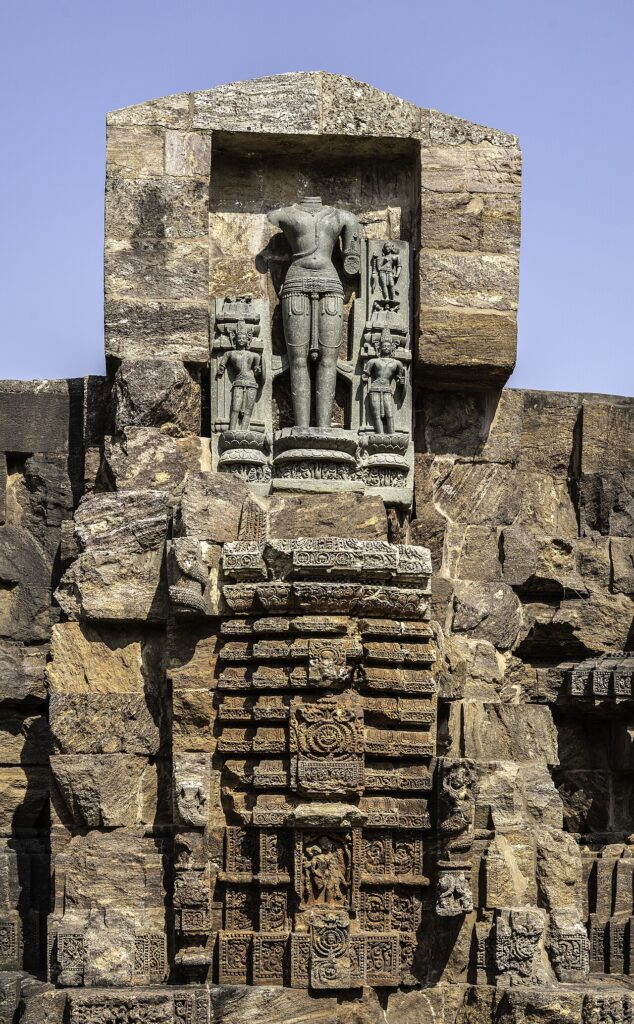
Architectural achievement during the Gajapati period represented the culmination of the Odishan temple-building tradition. While the great temples of Bhubaneswar and Puri had been built earlier, the Gajapati era saw the construction of numerous subsidiary structures, mandapas, boundary walls, and gateways that enriched the existing sacred complexes. The style of architecture evolved to incorporate new decorative elements, more elaborate sculptural programmes, and increasingly complex spatial arrangements. The Sun Temple at Konark, begun during the reign of Narasimha Dev I in the thirteenth century, was likely completed or substantially embellished during the early Gajapati period, and stands as the supreme achievement of Odishan architectural art.
Dance and music also received enthusiastic royal patronage. The classical Odissi dance tradition, which traces its origins to the ritual dances performed in the Jagannath temple, was systematised and refined during this period. The Devadasi tradition, whereby young women were dedicated to temple service including dance, reached its peak under Gajapati patronage. The musical traditions of Odisha were similarly enriched, with the development of new ragas and talas suited to the devotional and courtly contexts in which they were performed.
Administration and Economy
The Gajapati administration was a sophisticated system that combined centralised authority with a considerable degree of local autonomy. The empire was divided into several large provinces, each governed by a senior nobleman or royal family member who bore the title of Pariksha or Danda-natha. These provincial governors enjoyed extensive powers within their jurisdictions but were expected to maintain regular communication with the capital and to provide military support when required. Below the provincial level, the administration relied on a hierarchy of local officials who managed revenue collection, maintained law and order, and oversaw the operation of the judicial system.
The economy of the Gajapati empire was fundamentally agrarian, with rice cultivation forming the basis of wealth generation. The river deltas of the Mahanadi, Godavari, and Krishna were among the most productive agricultural regions in all of India, and the surplus generated from these areas supported the urban centres, the temple establishments, and the military apparatus. Maritime trade was another important component of the economy, with the ports of Puri, Kalingapatnam, and other coastal settlements serving as hubs for commercial exchange with Southeast Asia, Sri Lanka, and the western Indian Ocean world. Textiles, particularly the fine cotton and silk fabrics for which Odisha was famous, were major export commodities, along with spices, precious stones, and ivory products.
Legacy of the Gajapati Dynasty
The legacy of the Gajapati dynasty extends far beyond the territorial boundaries of their medieval empire. In the cultural memory of Odisha, the Gajapati period represents the high point of regional achievement, a time when Odishan civilisation made its most distinctive and enduring contributions to the broader tapestry of Indian culture. The association between the Gajapati title and the Jagannath temple continues to this day, with the current Gajapati of Puri still performing ceremonial roles in the temple rituals, maintaining a living connection to the traditions established five centuries ago.
The literary and artistic achievements of the Gajapati era laid the foundations of modern Odia cultural identity. The works of Sarala Das and the Panchasakha poets established the Odia language as a medium capable of expressing the highest literary and philosophical ideas, while the architectural and sculptural creations of the period remain among the most treasured monuments of Indian civilisation. The political traditions of the Gajapatis, particularly their concept of kingship as service to the divine, influenced subsequent political thinking in Odisha and the surrounding regions.
Perhaps most importantly, the Gajapati dynasty demonstrated that a regional power could aspire to and achieve imperial status within the fragmented political landscape of medieval India. Their ability to construct and maintain an empire stretching across linguistic, ethnic, and ecological boundaries testifies to a sophisticated understanding of statecraft and governance. Even as their political power waned in the face of external pressures and internal decay, the cultural and religious institutions they nurtured continued to thrive, ensuring that the Gajapati legacy would endure long after the last imperial banners had been lowered. The story of the Gajapatis remains an essential chapter in understanding the rich and complex history of Odisha and its enduring contributions to the civilisational heritage of India.